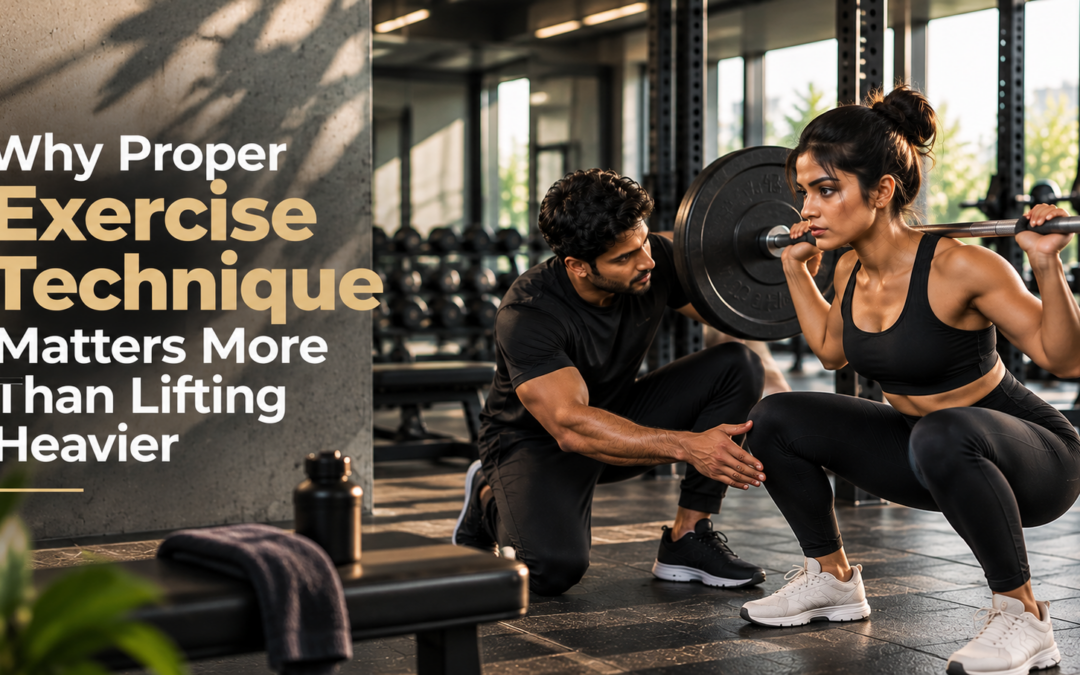
Walking into a gym and seeing someone lift a heavy weight can make strength training look simple: pick up more weight, do more repetitions, and keep progressing.
But effective training isn’t simply about how much weight you can move.
How you perform an exercise matters just as much.
Good technique helps you control the movement, understand what your body is doing, and build a stronger foundation for future progression. Whether you’re new to exercise or have been training for years, improving your technique can make your workouts more purposeful.
What Does Good Exercise Technique Mean?
Exercise technique refers to how you perform a movement.
It includes factors such as:
- Body positioning
- Range of motion
- Movement control
- Breathing
- Stability
- Tempo
- Coordination
The exact technique depends on the exercise.
A squat, deadlift, bench press, row, and shoulder press all require different positions and movement patterns.
Why Beginners Should Focus on Technique First
When you’re new to training, it can be tempting to increase the weight quickly.
However, your first priority should usually be learning how to perform the movement correctly.
This gives you an opportunity to understand the exercise before adding greater resistance.
Once you become comfortable with the movement, progression becomes much easier to manage.
More Weight Doesn’t Always Mean More Progress
Increasing resistance can be an important part of strength training.
But adding weight simply for the sake of lifting heavier isn’t necessarily useful.
If increasing the weight causes you to lose control, shorten the intended range of motion, or significantly change the movement pattern, the additional resistance may not be providing the benefit you’re looking for.
Progress should be based on quality as well as quantity.
Control Makes an Exercise More Meaningful
Consider two people performing the same exercise.
One person moves quickly and uses momentum to complete the repetitions.
The other performs the movement with controlled positioning and consistent technique.
The number on the weight may be the same, but the quality of the movement can be very different.
Learning to control an exercise gives you greater awareness of how you’re moving rather than simply trying to complete the repetition.
Range of Motion Matters
Another important part of technique is range of motion.
The appropriate range depends on the exercise, the individual, and their current mobility and ability.
Reducing the movement simply to handle a heavier weight may change the exercise.
This is why increasing resistance should not automatically come at the expense of movement quality.
Technique Can Improve With Practice
Good technique isn’t something you have to master immediately.
It develops through repetition and feedback.
As you become more familiar with an exercise, you may find it easier to maintain your position, control the movement, and understand where you should feel the exercise.
Regular practice can gradually improve your confidence as well.
Trainers Can Help You Identify Small Mistakes
Some technique problems are difficult to notice on your own.
You may think your movement looks correct because it feels normal to you.
A trainer can observe your movement from different angles and provide feedback that helps you make adjustments.
This can be especially useful for exercises that involve several moving parts.
For those considering Personal Training in Indiranagar, individual coaching can provide this type of direct feedback during workouts.
Everyone May Need Different Adjustments
There isn’t always one identical version of an exercise that works for every person.
Differences in mobility, strength, body proportions, experience, and training goals can affect how someone performs a movement.
A trainer can help determine whether an exercise needs to be modified or whether a different variation would be more appropriate.
Personalization is particularly useful when learning unfamiliar exercises.
Good Technique Supports Progressive Training
Once you have established a reliable movement pattern, it becomes easier to measure progress.
You can gradually increase resistance, repetitions, volume, or exercise difficulty while maintaining reasonable control.
This creates a more structured approach to progression.
Instead of simply asking, “How much can I lift?”, you can also ask, “Can I perform this movement well at this level?”
Don’t Compare Your Weight With Someone Else’s
Gym environments can make comparison easy.
You may see someone lifting much heavier weights and feel that you should be doing the same.
But their training history, body structure, experience, and goals may be completely different from yours.
Your focus should be on improving your own performance.
A lighter weight performed with good control can be more useful for you than a heavier weight that you cannot manage properly.
Technique Can Change as You Get Tired
Maintaining good form becomes more difficult when fatigue builds up.
This is why simply counting repetitions isn’t always enough.
Pay attention to whether your movement remains controlled toward the end of a set.
If your technique deteriorates significantly, it may be worth reconsidering the resistance, number of repetitions, rest period, or exercise selection.
Know the Difference Between Challenge and Poor Form
Training should feel challenging.
That’s part of the process.
But there is a difference between working hard and losing control of the movement.
A difficult final repetition can still be performed with reasonable technique.
If the movement changes dramatically just to complete the repetition, it may be time to stop the set or adjust the load.
Warm-Up Can Help Prepare You
A suitable warm-up can help you prepare physically and mentally for your workout.
Depending on the session, this may include light cardiovascular activity, mobility exercises, or easier versions of the movements you’ll perform.
A warm-up doesn’t need to be complicated.
Its purpose is to prepare you for the work ahead.
Technique Is Important at Every Fitness Level
It’s easy to assume that only beginners need to worry about exercise form.
That’s not true.
Experienced gym-goers can also benefit from reviewing their technique.
As resistance increases, small movement errors can become more noticeable.
Regularly checking your form can help you maintain good habits as your training becomes more demanding.
When Should You Increase the Weight?
There isn’t one universal rule for when to add resistance.
Consider whether you can perform the required repetitions with appropriate control and technique.
If the current resistance feels manageable and your movement remains consistent, your program may be ready for a gradual progression.
If you’re struggling to maintain technique, increasing the weight may not be the right next step.
Quality Before Quantity
A productive workout isn’t measured only by the total amount of weight lifted.
Quality repetitions, consistent training, appropriate progression, and good recovery all contribute to a sustainable fitness routine.
Learning to value movement quality can help you develop a better relationship with training.
Instead of constantly chasing bigger numbers, you can focus on becoming stronger and more capable over time.
Final Thoughts
Strength training is about progression, but progression doesn’t mean adding more weight every time you enter the gym.
Good technique, control, appropriate range of motion, and consistent movement are important foundations for long-term training.
Once you understand and perform an exercise well, you can gradually increase the challenge according to your ability and goals.
If you’re exploring Personal Training in Indiranagar, working with a trainer can give you the opportunity to receive individual feedback and learn how to approach exercises with greater confidence.
The goal isn’t simply to lift heavier. It’s to train better, progress gradually, and build a routine you can continue over time.