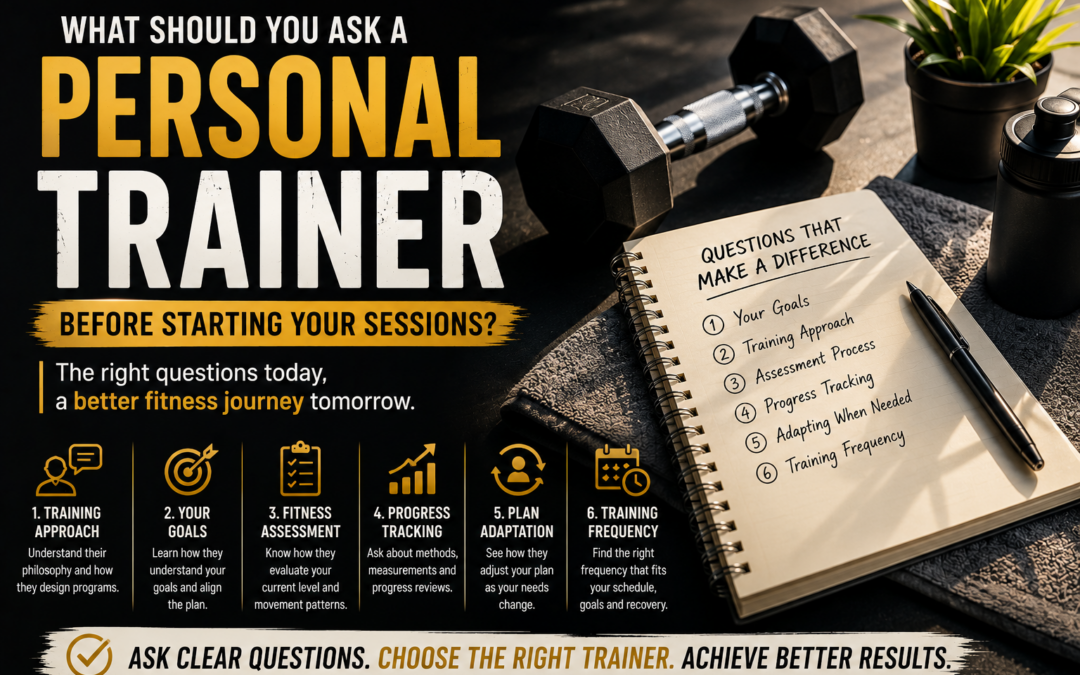
Choosing a personal trainer is a personal decision. The right coach can help you understand your workouts, improve your technique, stay accountable, and work toward your goals with a clear plan.
But not every trainer follows the same approach.
Before committing to regular sessions, it is worth having a conversation with the trainer and understanding how they work. Asking the right questions can help you determine whether their coaching style, experience, and approach are suitable for you.
If you’re considering Personal Training in Gym in Brigade Road, here are some important questions to ask before getting started.
What Is Your Approach to Personal Training?
Every trainer has a different coaching philosophy.
Some focus heavily on strength training, while others may prioritize functional fitness, mobility, conditioning, or a combination of different approaches.
Ask the trainer how they generally structure sessions and how they decide which exercises are appropriate for a client.
Their answer can give you a better idea of whether their training style matches what you’re looking for.
How Will You Understand My Fitness Goals?
A good personal training relationship should begin with understanding the client—not immediately assigning exercises.
The trainer should want to know about your:
- Fitness goals
- Current activity level
- Training experience
- Daily routine
- Exercise preferences
- Previous training experience
This information helps create a program that is realistic and relevant to you.
If a trainer does not take the time to understand your objectives, it may be difficult to build a truly personalized program.
How Will You Assess My Current Fitness Level?
Before progressing into challenging workouts, a trainer should have some understanding of your current capabilities.
Depending on your goals, an assessment may consider areas such as strength, endurance, mobility, movement patterns, and general fitness.
This provides a starting point from which progress can be measured.
It also helps the trainer avoid making assumptions about your abilities.
How Will You Structure My Workouts?
A personal training session should have a purpose.
Ask how the trainer plans to organize your workouts and how individual sessions will contribute to your larger goal.
For example, a structured program may gradually develop strength, endurance, mobility, or conditioning rather than changing exercises randomly every session.
Understanding the reasoning behind your program can also make you more engaged with your training.
How Do You Track Progress?
Progress isn’t always visible in the mirror.
Depending on your goal, improvement may appear through increased strength, better endurance, improved technique, greater mobility, or the ability to perform exercises more comfortably.
Ask how your trainer intends to monitor these changes.
Regular progress checks can help identify what’s working and where adjustments are needed.
How Often Should We Train?
The ideal training frequency depends on your goals, schedule, experience, recovery, and overall activity level.
There isn’t one number that works for everyone.
A good trainer should be able to explain why a particular schedule is appropriate for you rather than simply recommending more sessions.
Your training plan should be something you can realistically maintain alongside your everyday responsibilities.
How Do You Adapt Workouts When I’m Struggling?
Not every workout will feel the same.
You may arrive tired after a demanding day, experience temporary soreness, or find a particular movement uncomfortable.
Ask how the trainer adapts sessions when circumstances change.
A knowledgeable coach should be able to modify exercises, intensity, volume, or movement selection without losing sight of the overall objective.
What Happens When I Reach a Plateau?
Progress rarely happens in a perfectly straight line.
Eventually, many people experience periods where their results slow down.
A trainer should have a strategy for dealing with plateaus rather than simply repeating the same routine.
This may involve changing exercise selection, adjusting training volume, modifying intensity, or introducing a different progression strategy.
The important thing is that your program evolves as your body adapts.
How Do You Approach Exercise Technique?
Technique should be a major part of personal training.
Ask how the trainer teaches and corrects exercises, particularly movements that are new or technically demanding.
A good trainer should be comfortable explaining why proper positioning, movement control, and range of motion matter.
Learning these fundamentals can help you become more confident and capable in the gym.
How Do You Keep Sessions Challenging Without Making Them Excessive?
A productive workout should challenge you, but more intensity isn’t automatically better.
Training needs to be balanced with recovery.
Ask how your trainer determines when to increase the difficulty of an exercise and when to allow more recovery.
This can help ensure your program progresses at an appropriate pace rather than pushing you unnecessarily hard.
Can Your Training Style Fit My Schedule?
Your trainer’s expertise matters, but so does practicality.
If your work schedule changes frequently, explain that from the beginning.
A realistic training plan should fit into your lifestyle rather than becoming another source of stress.
This is particularly important for professionals looking for Personal Training in Gym in Brigade Road who may have demanding and unpredictable schedules.
What Should I Expect Outside the Training Session?
Personal training isn’t always limited to the hour you spend with your coach.
Depending on the trainer and your goals, you may receive recommendations regarding activity levels, recovery, mobility, or other aspects of your fitness routine.
Ask what kind of support or guidance you can expect between sessions.
Knowing this beforehand helps establish clear expectations.
Pay Attention to How the Trainer Communicates
The answers are important, but the conversation itself can tell you a lot.
Does the trainer listen carefully?
Do they explain things clearly?
Are they interested in your goals?
Do they encourage questions?
Do they make you feel comfortable discussing challenges?
A strong trainer-client relationship depends on communication and trust as much as technical knowledge.
Final Thoughts
Choosing a personal trainer should involve more than checking availability and booking your first session.
Take the opportunity to ask questions about their coaching approach, assessment methods, workout planning, progress tracking, and how they adapt training to individual needs.
The right trainer should give you confidence that your workouts have a purpose and that your program can evolve as you improve.
If you’re exploring Personal Training in Gym in Brigade Road, taking the time to have this conversation before starting your sessions can help you find a coaching approach that genuinely fits your goals, lifestyle, and expectations.